Pre-configured instrument bundles and measurement methodologies tailored to the testing challenges of your industry.
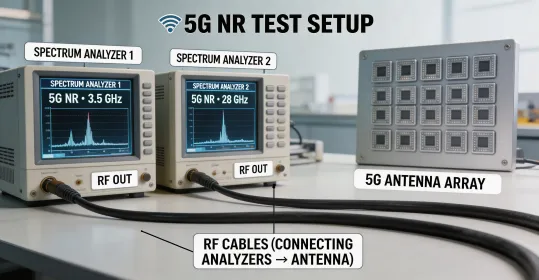
End-to-end test solution for 5G NR sub-6 GHz and mmWave deployments. Includes spectrum analysis, signal generation, and automated conformance scripting. Covers FR1 (410 MHz - 7.125 GHz) and FR2 (24.25 GHz - 52.6 GHz) bands with OTA measurement capability.
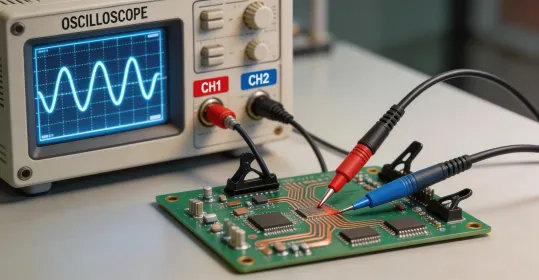
Oscilloscope-based solution for PCIe Gen 5/6, DDR5, USB4, and Ethernet compliance testing. Combines real-time oscilloscopes with eye-diagram analysis software and automated margin reports.
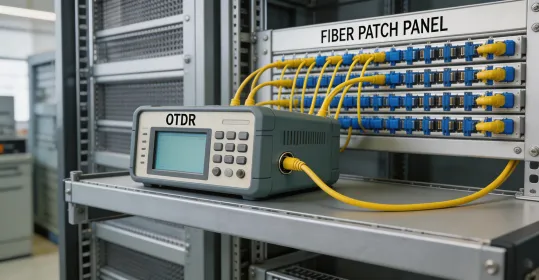
OTDR, optical power meter, and fiber inspection probe packaged for rapid link qualification. Supports single-mode and multi-mode testing with automated Tier 1 and Tier 2 pass/fail verdicts per TIA-568 and ISO 11801 standards.
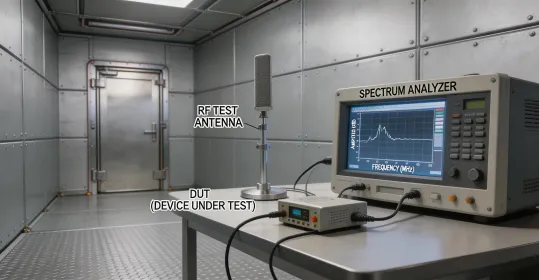
Spectrum analyzer, near-field probe set, and LISN configured for radiated and conducted emissions screening per CISPR 32 and FCC Part 15. Identify emissions issues early, reducing costly re-tests at accredited labs.
Choosing the right test architecture involves trade-offs. Below are two common decision points our applications engineers help customers navigate.
Carriers deploying 5G face a fundamental infrastructure trade-off. mmWave bands (FR2, 24.25-52.6 GHz) deliver massive bandwidth up to 800 MHz per channel and ultra-low latency suited to dense venue coverage and industrial IoT, but require significantly higher cell-site density and specialized OTA test chambers. Sub-6 GHz (FR1, 410 MHz-7.125 GHz) provides superior coverage and building penetration with lower infrastructure cost, making it more practical for nationwide rollout. Most operators pursue a hybrid strategy, and the test instrumentation must cover both frequency ranges. Our 5G validation suite supports FR1 and FR2 in a single platform to avoid duplicating equipment.
The choice between deploying fiber-to-the-premises (FTTP) and leveraging existing copper with technologies like G.fast or VDSL2 vectoring depends on bandwidth roadmap, budget, and existing plant condition. FTTP offers future-proof capacity (10 Gbps+ per subscriber), lower long-term maintenance, and superior latency, but requires higher upfront civil works investment. Enhanced copper can deliver 1 Gbps over short loops at a fraction of the deployment cost, extending the life of existing infrastructure. For test and certification, fiber links require OTDR and optical power meter verification, while copper upgrades need DSL line qualification and crosstalk analysis. We supply instruments for both scenarios.
Each instrument family has defined frequency ceilings. Our oscilloscopes cover up to 33 GHz bandwidth; spectrum analyzers reach 44 GHz. Applications requiring measurement above these ranges (e.g., E-band 60-90 GHz or W-band radar) require external frequency extension modules or specialized millimeter-wave instrumentation not currently in our catalog.
Standard bench instruments are rated for 0 to +50 C operating temperature and 20-80% relative humidity (non-condensing). Field-rated instruments (MIL-STD-810 compliant) extend to -40 to +55 C but carry a 15-20% cost premium. Extremely humid tropical deployments may require additional protective enclosures not included in standard kits.
Published accuracy specifications assume calibration within the recommended 12-month interval. Instruments used in harsh field conditions (temperature cycling, vibration, dust) may experience accelerated drift and should be recalibrated at 6-month intervals. Calibration services add ongoing operational cost that should be factored into total cost of ownership calculations.
Our applications engineers work with your team to understand the DUT, test parameters, accuracy requirements, and throughput targets.
We assemble the instrument bundle, develop test procedures, and validate measurement uncertainty budgets against your specifications.
On-site installation, operator training, and ongoing calibration support maintain repeatable results throughout the instrument lifecycle.
Tell us about your measurement challenge and we will recommend the right instrument combination for your application.
Talk to an Engineer